Sunday, 22 November 2020

Assignment 1 Reflection (sorry it's late!)


As far as first assignments go, I was really impressed with how our group gelled together. I had the pleasure of working with Karishma and Ivan on the ancient Babylonian problem regarding Sagitta and Chord. What worked really well for us was delegating work evenly, but also providing critical feedback to each other so we could continuously build upon ideas. This reminds me of many of the things we talk about in class such as collaboration with other teachers to have better lesson plans/classes. I feel because of this we were able to have a better flowing presentation, but also had our own ways of explaining the problem. My part of the presentation was to think of the extension question/problem, and I tried my best to have fun with it. I've found that practice math questions can be boring for students, so I try to find ways to make them exciting. In class during our brief post-discussion Susan mentioned how kids may relate better to dragons than squares and circles, something that resonated with me as part of the fun in math is creating problems that extend from the imagination! 

In terms of the actual material, it was different putting myself in a Babylonians' 'shoes' and figuring out the applications of the mathematics. One of the cool pieces I learnt from Karishma was how the Sagitta and Chord could possibly be used for building archways like the Ishtar Gate. The mathematical advancements that the Babylonians had was almost indescribable, they were so much further ahead of their time. 

Tuesday, 17 November 2020

Dancing Euclidean Proofs

The first thing that stopped me when reading this article was how I could find a way to physically implement mathematics into something I'm passionate about: hockey. It didn't have to be about Euclidean proofs necessarily, but more geared to embodied learning as a whole. I think that sports is a great way to show embodied learning and can have really great physical representations, especially with something like skating that allows gliding and movement of the puck, or even the use of the stick. If I were to translate ice to the dancing Euclidean proofs, perhaps the use of figure skating could be used. With hockey however I could create drills or skating patterns that would represent mathematical proofs, or even mimic the first Euclidean proof dance as a drill that could work on edgework and skating. While reading the article all I could think of was how I could implement these ideas into something I love.

A quote that made me stop was "If you sit down to study the Elements from a book, you are in a sense completely detached from its representation on the page" . What I found so interesting about this was of course that I have experienced this detachment in other subjects or even with math. I feel this is a reason why math can be seen as 'boring' for some students, as rigorous proofs through text may just be words on a page that they don't care for. Over the short practicum what I've learnt is kids do not learn well when all they do is sit in their seats and take notes or read -- the more they move and become part of the work, the more they become engaged and focused. I think that math is notorious for having proofs that are boring and hard to understand for most people, so having embodied learning really gives the student a better sense of how proofs may work.

A second quote that stems from the first is "You become the active agents responsible for the making and understanding the representation" , and although this has to do with dancing in the text, in reality this is what we want all of our students to be able to do. We want to give them the necessary tools and knowledge to understand the material, but we want them to actively engage with it and form relational understandings through whatever form they're most comfortable with. We should encourage students to learn through analogies or physical representations, as it can give the context a sense of realism and practicality. I remember in physics we used the right hand rule, this physical representation really made sense of how forces may work on an object and therefore made the content easier.

Friday, 6 November 2020

Euclidian Poems

Why is Euclid the father of geometry? - Quora

Euclid is credited as being one of the founders of geometry, having influenced and proved many theorems that have set the basis for what is commonly referred to as Euclidean Geometry! In Euclid's Elements, rigorous mathematical proofs are used to lay the foundation for geometry. 

The poem written by Edna St. Vincent Millay is particularly interesting in the sense that it seemed like an ode to Euclid, praising that he "alone has looked on Beauty bare". What's interesting is the capitalization the word Beauty, almost personifying it and giving the word meaning. I believe what the author is trying to say is that by working rigorously through mathematical proof, Euclid has seen beauty in an existential form and perceives the world differently than 'most people'. She is putting Euclid on a pedestal and saying he is an intellectual far beyond anyone else as he "alone" has seen Beauty. She then reiterates this at the end of the poem by saying "fortunate they who, though once only and then but far away, have heard her massive sandal set on stone" she is referring to people who have come close have only seen 'her' (referring to Beauty) 'massive sandal set on stone' once again personifying and giving life to the term; but also showing the distance between Euclid and others. While he has witnessed Beauty bare, others have only heard the sandal set on stone, and that is as close as they've gotten. I believe that this poem is made to make Euclid seem like an intellectual like no other; no one comes close to his levels of intellect, and it seems like no one ever will.

The second poem by David Kramer however seems more like a direct opposition to the ideals of the first poem. From the first line "Euclid alone has looked on Beauty bare?" the mere idea that Euclid is better than all is put into question immediately. I believe the poem is criticizing those who put Euclid on a pedestal in the lines "As you sang praise, Orpheus, of Eurydice, Your mouth became the orifice of your idiocy!". The story of Orpheus and Eurydice is a tragic one. To summarize: Orpheus lost his wife and visited the underworld to convince Hades to let her return; he said he would grant this wish, but Orpheus would have to walk back from the underworld and trust that Hades had let her follow behind him. Orpheus was thus instructed not to turn around and trust Hades that she will be following him. Orpheus almost made it to the end, but his anxiety got the best of him, thinking the Gods had tricked him, so he turned around only to see his wife Eurydice's shadow wisp away. I think the poem really targets on the turning around aspect and to continue looking forward. Yes, it is great to praise artists and scientists for their works, but to idolize and say they are the most intellectual people to ever exist is a disservice to other greats. "Has no one else of her seen hide or hair? Nor heard her massive sandal set on stone? Nor spoken with her on the telephone?" I believe this line is expressing that other people have come just as close to Euclid on seeing true Beauty and should be respected for that reason. 

Monday, 19 October 2020

Eye of Horus

Researching this was so much fun, I remember in grade 7 we had units on Greek, Roman, and
Egyptian Mythologies, I always found their stories of their Gods to be so exciting. I had seen the Eye of Horus before, but at first I thought it was the Eye of Ra; Ra being a god of the sun. Both eyes are connected to one another and represent similar concepts, but learning of the Eye of Horus was extremely interesting. The Eye of Horus has been seen as a symbol of protection, royalty, and good health; the eye was lost in a battle and magically healed and restored -- the restoration symbolized making whole and healing, cool!

According to the myth, the eye was separated into pieces and lost, each part of the eye representing a different fractional value (1/2, 1/4, 1/8, 1/16, 1/32, and 1/64), and different part of the eye. What I found most interesting was that "these fractions, all with powers of two in their denominators, were used to represent the fractions of hekat, the unit measure of capacity for grains" (source). This ties into what we were learning in class, and how ancient Egyptians may have used calculations for something like payment in wheat, or hekat in this case.

Two things popped into my mind when I thought of 'special meanings of numbers', the first being anniversaries, and the next being lucky numbers. Anniversaries, being represented by dates, can also be represented numerically. These dates can have special meaning to the individuals it effects, we often celebrate my parents anniversary every time it comes around! Another example would be 'lucky numbers'. I've played hockey for over 20 years now, and been coaching for the past 8. One thing I've always noticed with teammates and players is how excited, protective, and disappointed they can be towards their jersey numbers. Some players are so attached to their numbers that they find identity within it, and feel dejected or disappointed when they don't receive it. It's easy to say "your number doesn't define you", but players can be extremely superstitious. 
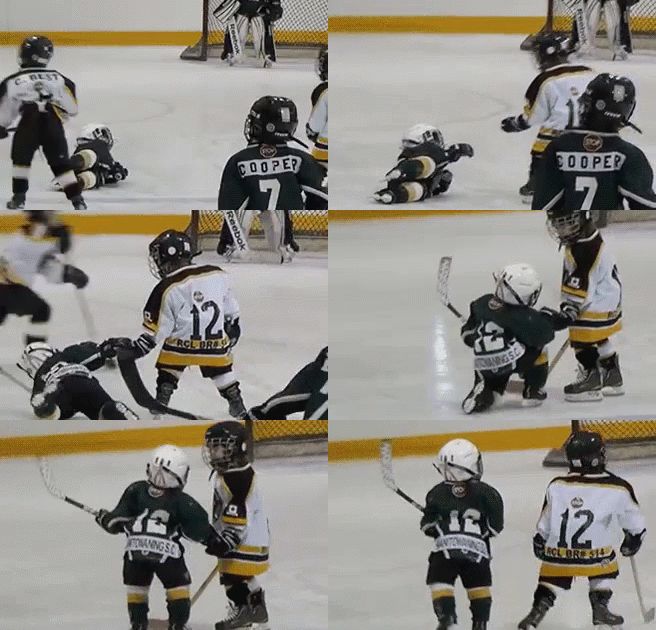

Personally, my favorite number, and number I've played with since I was around 8/9 was the number 10. My story with it is: when I first started playing, I always wanted my jersey number to match how old I was. Somehow, when I was 8 I took 10, so I told myself I would wear 10 until I was old enough, then move onto 11 when I turned 11; but after 2 extra years of wearing the number, I somehow got attached! I haven't changed my number since 

Constructing a Magic Square


 I was first introduced to the concepts of the Magic Square in this video: A Sudoku With Only 4 Given Digits. As an aside, this Sudoku video was unbelievable to watch someone solve; I struggle enough with the basic versions of Sudoku, let alone this kind of stuff!


I remember when it was first mentioned, I thought it was such an interesting idea that almost didn't seem feasible. It felt a little unfair making this then because I had some previous knowledge of how to approach it (although I didn't completely remember how to solve it). The one thing that I remembered was important was the number 5, as when we construct the possibilities of 3 numbers added together between 1-9 to equal 15, 5 was the most common number that allowed the most possibilities, therefore it was placed in the center square. 

The easiest way to approach this was deciding what would happen with 1. If I added 1+5+9 I get 15, but I also get 1+6+8 to be 15 too. If 9 was on the diagonal, then it has to intersect with 6 or 8 on the vertical or horizontal! The problem with that is it's >=15 with only 2 values, so we know that wouldn't work. So I then wrote 1 and 9 on the horizontal and was able to solve the square going from there! It helped to write out a couple other equations that would help me logically reason through the pattern of the square. Once I was able to have 2 equations down (1 + 5 + 9 and 6 + 1 +8), the rest logically followed as there was a missing spot in the top right corner where I was able to fill in the 2...and so forth. It reminded me of a Sudoku puzzle as well, once you know the spot of a few numbers, the rest seem to flow!

Saturday, 10 October 2020

Method of False Position Example


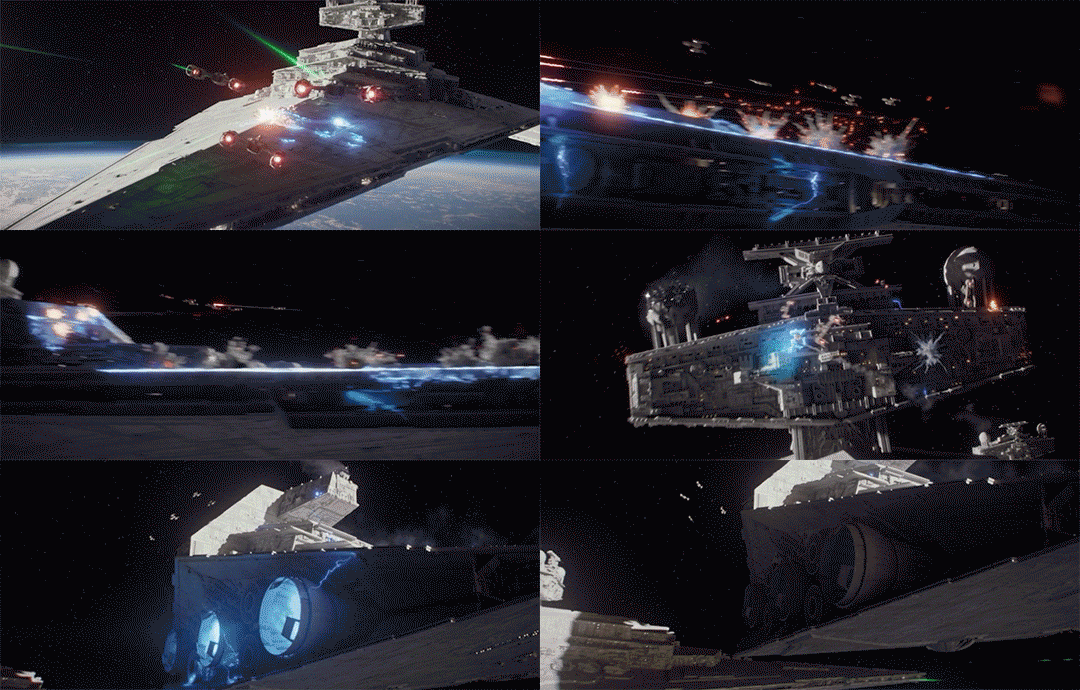
2 spaceships are intertwined in a galactic fight; each have a limited number of lasers to fire. One pilot fires one sixth of their lasers and are left with 40 shots left; how many lasers did that pilot start with? 

Solution:
x - x/6 = 40
(try x = 6)
6 - 6/6 = 6-1 = 5 
since 40/5 = 8, we can try x = 48 
48 - 48/6 = 48 - 8 = 40
So the pilot initially had 48 shots

A Response to Was Pythagoras Chinese

  I believe that acknowledging non-European sources of mathematics makes a big difference to the students. The western schooling system is very Euro-centric, and it's extremely prevalent in mathematics; all theories seem to come from the Ancient Greeks, and it can give the student the impression or underlying belief that only white males are capable of finding such theories. Acknowledging non-European sources of mathematics may give students of different backgrounds someone to look up to, or connect them to their culture. Also, as teachers it is our job to give accurate and correct facts, so when we acknowledge only part of history, we are doing disservice to our students. I think the best way to connect this is: imagine you created some new invention, succeeded locally, and had recognition from those in your city. You're the only person in that market (you're aware of) for years, and one day someone across the continent announces they've come up with a 'new invention', which is the same as yours. Now imagine if that other person, who claimed to have discovered this invention, gets all the praise and glory for it, and is taught about for years to come. This is what happens when we do not acknowledge the other cultures that had similar discoveries, hundreds of years before. We are discrediting them, when we should be celebrating their achievements! 


I believe that theorems shouldn't be named after people, as we've learnt that there is no historical accuracy to whether that person 'really' discovered it or not. We've also learnt that different civilizations have come up with similar theories, in different time periods, but have named them differently. For example, Pythagoras was the first to come up with a proof (or was he?) for the right-triangle, but he wasn't the first person to notice or use it, as the Gougu theorem was used by the Chinese. I believe that theories should be named after what they solve, like Pythagoreans theorem should really be named: Right Triangle Theory (as stated in the text), as this doesn't assign credibility, but also centralizes terminology.

Course Reflection

  I didn't know what to expect when I first entered this course, I had reservations about 'math history' and honestly thought it...